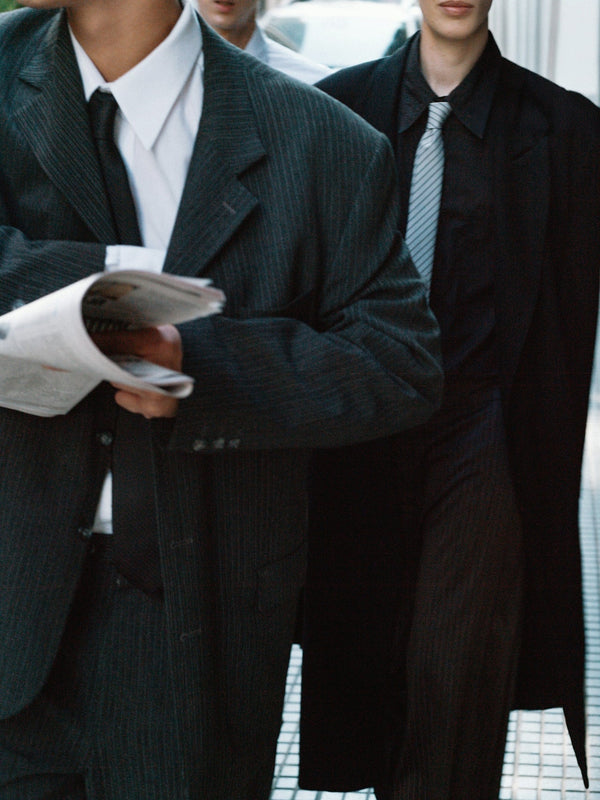
Most clothing is designed for the average, average movement, average sensitivity, average perception, all built on the quiet assumption that the person wearing it won't notice the seam slightly out of place, the fabric that shifts throughout the day, the weight that never quite settles.
For most people, that assumption holds. For others, it doesn't.
Some of us experience our environment differently. We notice more, not in a poetic sense, in a functional one. How materials sit against the skin, how weight distributes across the body, how small inconsistencies stack up across the course of a day. Individually, these variables are negligible. Collectively, they become drag. And drag, accrued over time, becomes cost.
The cost isn't dramatic. It doesn't show up as failure, it doesn't announce itself cleanly. It shows up as distraction that shouldn't be there, irritation without a clear source, energy spent managing something that should be neutral. And most systems aren't built to account for it. Clothing included.
The majority of apparel is optimized for scale, for trend cycles, for visual appeal. Not for consistency, not for control, not for the reduction of sensory noise. This isn't a flaw in execution, it's a flaw in assumption. The baseline user most brands design for is incomplete, and when the baseline is wrong, everything downstream is too.
When the drag is gone, something subtle happens. Focus stabilizes, attention holds longer, and the energy that was getting spent on managing low-level discomfort becomes available again. This isn't about comfort in the traditional sense. It's about control of your environment.
Designing for this doesn't mean more features, more softness, or more stretch. It means more precision. Weight that grounds instead of floats, fabric that maintains its structure instead of collapsing, construction that eliminates variables instead of introducing them. Every decision becomes intentional, because the margin for "it's fine" is smaller.
Most people don't notice any of this, which is why the problem stays invisible. And when it does get discussed, it tends to get categorized in ways that shrink it: medicalized, simplified, boxed up and filed away. But for many of us, it isn't something to be managed. It's how we're wired to run.
If you already operate this way, you already know. You've already figured out the rest of your environment, how you work, how you structure your day, what you allow into your space. Clothing is simply one of the last systems to catch up.
CONTRA CLASS is built on a different assumption: that what you wear shouldn't add drag to your day, that materials, weight, and construction should work with you instead of against you, that consistency isn't optional, and that control, at every level, compounds.
Most clothing is designed for the average.
It works. Until it doesn't.