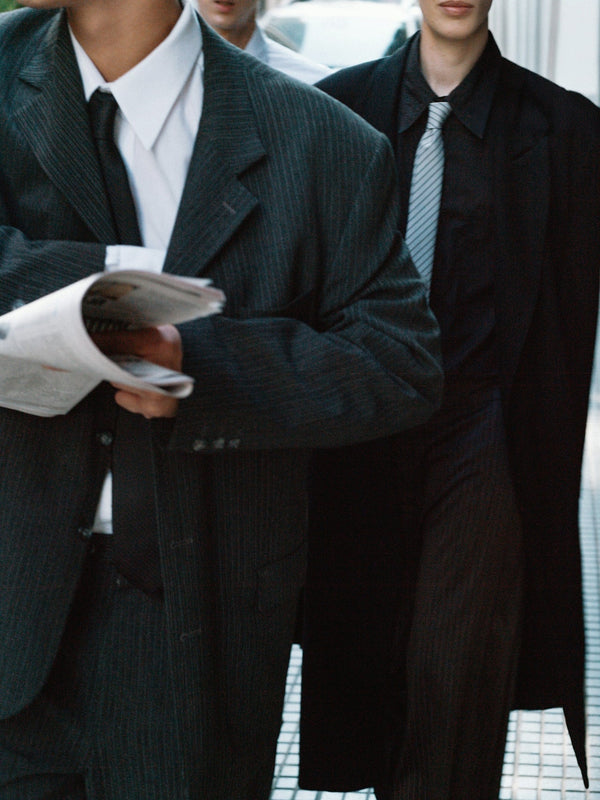
Comfort isn't a feeling. It's a line item.
Most of the industry treats it like an afterthought, something you get around to after the design is locked, after the fabric is sourced, after the margins are set. It gets filed under preference. A soft benefit. Subjective, therefore optional.
That filing is wrong, and it's expensive.
Here's the thing: comfort is a variable, and like any variable in a system, it shapes the output. The second you start operating under real pressure, the math changes. Long days, high stakes, sensory load stacked on top of whatever you're already trying to do. You stop caring how the garment looks in a photograph and start caring whether it still behaves at hour eight the way it did at hour one.
That isn't preference. That's performance.
The miscategorization shows up everywhere. Materials get picked because they photograph well, construction gets optimized for scale, and small inconsistencies get tolerated because most people filter them out without noticing. For most of the market, that works. The system runs.
But not for everyone.
Some of us register our environment differently, not dramatically, just consistently. We notice how weight sits across the shoulders, when a fabric starts to shift instead of holding its structure, where the seam is, where the tension point is, whether the tag was cut flush. The things most people filter out automatically, we don't.
Individually, each one of those is minor. A small adjustment, the kind of thing you could, in theory, just ignore.
But systems don't run on isolated moments. They run on accumulation.
A minor distraction, repeated, becomes a running cost. Nothing catastrophic, just accrued. Pulled attention, leaked focus, a little bit of bandwidth gone all day long while you're trying to do literally anything else. That's the real line item, and it doesn't show up on any spreadsheet because it hides. It presents as "I'm tired," or "I can't focus today," or a vague sense that something is off and you can't name it.
The people who notice are usually the same people who've already reconciled the rest of their environment. They've worked out how they think, when they do their best work, what they let into their space and what they don't. They've learned, usually the hard way, that performance isn't purely internal. It's shaped by everything around it.
Clothing is one of the few variables that stays constant through all of it. It's always there, always in contact, always contributing something whether you asked it to or not. And most of the industry treats it like it isn't part of the equation at all.
When you start treating it that way, the design priorities shift.
The goal stops being softness, because softness is a moment. The goal becomes consistency, predictability, a garment that introduces fewer variables instead of more, weight that stabilizes instead of distracting, fabric that holds its structure instead of degrading out from under you, construction that stays quiet instead of slowly turning into background noise.
The objective isn't "feels good at checkout." It's "removes interference over eight hours."
This isn't the industry standard because it doesn't need to be. Most people can tolerate the noise. They adjust, consciously or not, and move on. The system works well enough for them.
For the rest of us, tolerance isn't the goal. Control is. Control over how something behaves, how it feels at hour one and hour eight, whether it contributes to clarity or quietly pulls attention away from it. That level of control doesn't usually exist in clothing, not because it can't, but because it hasn't been the priority.
CONTRA CLASS lives in that gap.
Not as an aesthetic, but as a different starting point, where clothing gets treated as part of the system you operate within rather than something layered on top of it. Every decision gets made with the understanding that small variables, repeated over time, aren't small. They are the system. And when they're removed, what's left isn't just comfort, it's stability, it's consistency, it's the ability to direct your attention where you actually want it without paying for the privilege.
That isn't luxury. That's a condition for performance. If any of that lands, you already know it.